
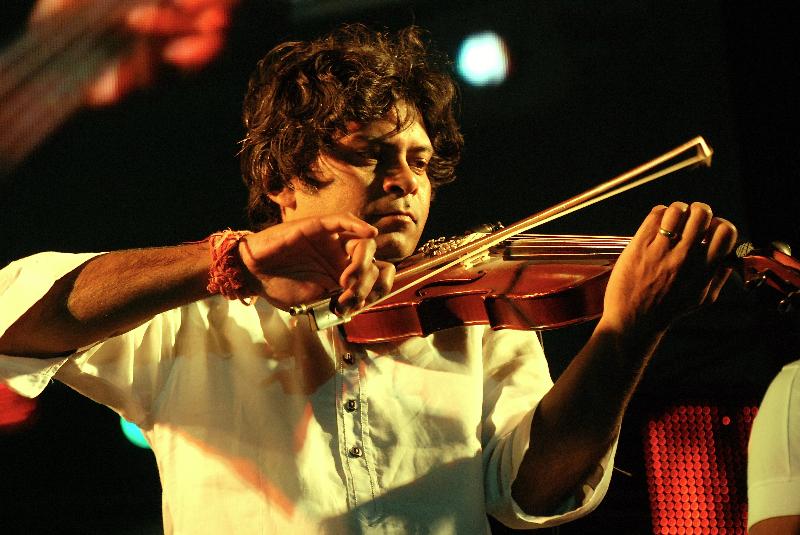

The veteran violinist and bandleader of fusion act Mrigya on the crossover from Hindustani classical to Western music and sharing the stage with Sting
The diversity of culture in India is quite amazing. From having 25 official languages and an enormous number of dialects, It is natural for an artist living in India to be exposed to several influences from one’s environment. The rich cultural heritage of India owes a great deal to its diversity.
It also makes an artist resilient and broad-minded about the musical influences in his or her domain.
Sharat Chandra Srivastava is an accomplished violinist strongly rooted in Hindustani classical music. His career has been dedicated to playing and teaching this discipline to a generation of students. Sharat has used this strong musical base to interact musically with musicians, both international and domestic, whose playing conforms to another discipline. The resulting end product goes beyond the realm of ‘fusion’ and into music that sounds like converging streams rather than something held together by rhythm alone.
We reached out to Sharat Chandra Srivastava to discover, from his perspective his experiences and discoveries from a lifetime of expanding and exploring musical possibilities.
A few excerpts from a long dialogue we had with this versatile musician:
Rolling Stone India: The background, early teachings and inspirations and guidance often define a musician. Tell us about your musical roots absorbed from your family. Hindustani classical music also involves a guru and following his tradition.
Sharat Chandra Srivastava: I was born into a creatively rich environment that deeply shaped my artistic journey. My father was a photographer and filmmaker based in Bombay. Later I grew up in Delhi in the midst of a cultural environment.
My mother was a science teacher and brought a strong academic background to our home.
Music entered my life early through my grandfather Pandit Joi Srivastava, a respected violin player from Allahabad. Our home was frequently filled with music where eminent musicians would come for mehfils which went on late into the night.
When I think about my influences and mentors, especially in terms of violin playing, my grandfather, Pandit Joi Srivastava and Pandit V.G Jog have always been at the centre of my journey.
What does it mean to be a classical musician in the present time when audience attention span is so short?
Is the classical music community in India shrinking in these times? What do you think of so many musicians who are making several compromises with traditional music?
No, it is not shrinking, rather it is really evolving and changing its course; the format itself is shifting. In my growing years, going to a concert meant sitting through a single raga for an hour and a half or two, listening to great maestros unfold it slowly and deeply. That immersive format is definitely changing now. These days the traditional structure – the aalap, jor, jhala followed by bandish and vilambit teental still exists but concerts have become much shorter. You might even hear three ragas in one hour! You now have even 30-second reels where an artist will present a raga through a couple of fast taans! It is a way to engage young audiences.
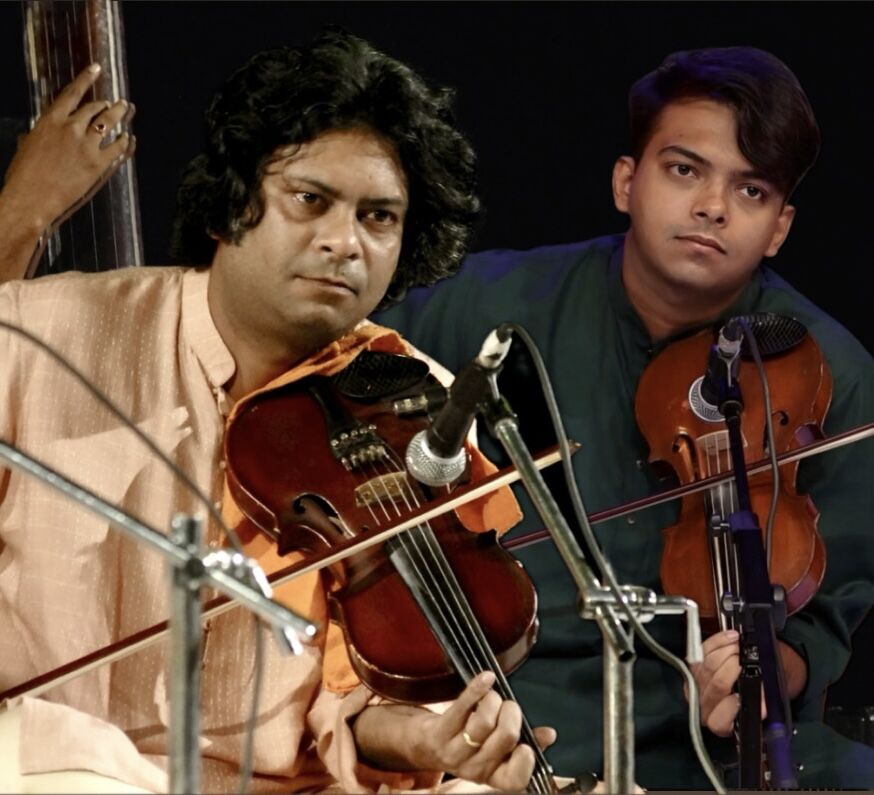
My advice to my son Raghav, also a Hindustani classical musician, is not to go there but rather follow the time-tested tradition and stay in the ocean of pure Hindustani classical music.
What has changed is the method of presenting our classical ragas.
Tell us about the various Gharanas and why they are different.
There are so many gharanas – schools of music in north Indian or Hindustani classical music and each has its own distinct character; some gharanas are known for their bandish or compositions while others place a strong emphasis on taans.
Historically, these gharanas were shaped by great musicians who were often patronized by royal courts. A style would evolve but it would qualify as a gharana when at least three generations had carried forward and developed the style and lineage.
In my playing, I don’t see these gharanas in isolation and like to absorb the best elements from each and bring them into my playing. I have also been influenced by Carnatic violin traditions
A fascinating aspect of Hindustani music is that even instrumental artists have to vocalize the music. Why is that?
When you begin to learn an instrument, you naturally start with technique and basic exercises. You then gradually move towards learning a composition, the bandish. Now the bandish fundamentally comes from vocal music; it is rooted in gayaki, the art of singing. In order to understand and internalize that gayaki, an instrumentalist has to engage in singing. In our training we didn’t just play the composition, we sang it too.
In Hindustani classical music, the role of the tabla, pakhawaj and other percussion instruments is vital. Why is this so? How do you see their significance?
Along with the gayaki, it is important to understand the rhythm. Studying percussion, whether it is the tabla, mridangam, ghatam or pakhawaj gives you a deep insight into taal. When you learn, in percussion, the bols, the chalan, the peshkar, the kaida and the tihai, you truly understand the rhythmic structure and movement. Ultimately, it is the combination of gayaki, swar and taal that shapes a musician.
When it all comes together, the expression that emerges becomes far richer and your individual baaj (style) gains depth and character.
Let us talk about your reaching out beyond your traditional realm of classical music and delving into sounds from other, mainly international backgrounds.
Why do you choose to reach out to other music forms?
In 1992, I was invited to and joined the pioneering rock band Parikrama, bringing a Hindustani classical influence into the rock genre. This phase was instrumental in shaping my understanding of cross genre collaboration and live performance at large scale festivals.
In 1999, I formed my own world music ensemble, Mrigya. I wanted to explore raga-based fusion. We quickly gained recognition and performed at international platforms such as the Edinburgh Festival Fringein 2001 and 2002 where we got critical acclaim and a five-star rating. Mrigya has remained a central part of my artistic identity. However, my journey has been rooted in tradition enriched by experimentation and guided by the belief that every musical experience offers an opportunity to grow.
Then in 1999 we were putting together a percussion act for a concert series in Delhi called Friends of Music, curated by Sanjoy Roy. I suggested we add a melodic element. They invited me to join in and almost overnight we created a set of compositions. Right after the concert we were invited to perform at the Edinburgh Fringe Festival. From there the collaborations started growing and that launched Mrigyainternationally. Scotland gave us Celtic influences, Spain introduced flamenco to our vocabulary.
Another turning point came in 2005 when we met Igor Bezget, a Slovenian guitarist; that is when jazz entered my life in a deep way. Until then I was exploring fusion, rock and World music but jazz brought in a completely new dimension.
Around the same time we also connected with Heiko Dijker, a brilliant tabla player from Holland. Interestingly, both Dijker and Igor Bezget had come to India to study Indian classical music, so we were exchanging musical worlds, each absorbing the other’s discipline and creating a global sound. This was like a dream come true – to play Indian classical violin in a Western music setup.
Every tour, every collaboration brings in a new musical language. For us, this journey has been about discovering meeting points between cultures and giving it musical expression.
My most incredible experience was playing with Sting at the Channel V Music Awards [in 1998]. It was a truly special three days I got to spend with him. Our conversations were centred around ragas, their theory and underlying concepts
Is music universal from a musician’s point of view?
Absolutely! Music is universal. I often think of music like a tree. From a distance it is just a tree, but as you come closer you see the trunk, branches, leaves and so many other details. But a tree is a tree everywhere. In our music we explore different parts of the tree, add something different to the branches and leaves but leave the tree intact.
And then a jazz riff, for instance can often find resonance with a tabla kayda, a bandish or even the essence of a raga.
What are your plans for the future?
My plans for the future are really the same as always – to keep exploring music, keep working at my craft through daily riyaz and teaching students regularly, including my son Raghav.
My band India Alba will be performing at the Edinburgh Book Festival for William Dalrymple around his new book, The Golden Road, which explores the common cultural history between India and Scotland. We will also be doing a few concerts around Scotland.
I have also created my own festival, Strings of the World,in 2012. The idea is to invite musicians, especially string players from across the world and create a platform for collaborative performance.
At the core of it all, my journey remains very simple – to keep evolving and keep dedicating myself to the music.

