



Article content
Days after Nepal’s worst natural disaster in a decade, Kathmandu’s biggest hospital was overrun — not with patients, but with families desperately looking for them.

THIS CONTENT IS RESERVED FOR SUBSCRIBERS
Enjoy the latest local, national and international news.
- Exclusive articles by Conrad Black, Barbara Kay and others. Plus, special edition NP Platformed and First Reading newsletters and virtual events.
- Unlimited online access to National Post.
- National Post ePaper, an electronic replica of the print edition to view on any device, share and comment on.
- Daily puzzles including the New York Times Crossword.
- Support local journalism.
SUBSCRIBE FOR MORE ARTICLES
Enjoy the latest local, national and international news.
- Exclusive articles by Conrad Black, Barbara Kay and others. Plus, special edition NP Platformed and First Reading newsletters and virtual events.
- Unlimited online access to National Post.
- National Post ePaper, an electronic replica of the print edition to view on any device, share and comment on.
- Daily puzzles including the New York Times Crossword.
- Support local journalism.
REGISTER / SIGN IN TO UNLOCK MORE ARTICLES
Create an account or sign in to continue with your reading experience.
- Access articles from across Canada with one account.
- Share your thoughts and join the conversation in the comments.
- Enjoy additional articles per month.
- Get email updates from your favourite authors.
THIS ARTICLE IS FREE TO READ REGISTER TO UNLOCK.
Create an account or sign in to continue with your reading experience.
- Access articles from across Canada with one account
- Share your thoughts and join the conversation in the comments
- Enjoy additional articles per month
- Get email updates from your favourite authors
Sign In or Create an Account
or
Article content
On Saturday, Sukuntala Bhatta was one of those family members. She paced outside with her husband and other relatives, scanning hospital records, buttonholing staff and waiting in hope that her 22-year-old son, a hotel worker near the China-Nepal boundary, had survived the flash flood that unleashed devastation on both sides of the border earlier this week.
Article content
Article content
Article content
Article content
One challenge was complicating her search. The hotel where Bhatta’s son, Om Prakash Bhatta, worked was situated on the Chinese side. She didn’t know how to contact Chinese authorities for information about him. Nor did she know if her son — if he was alive — would be taken to Nepal, or if he was perhaps in a hospital in China somewhere, and out of reach.
Article content
By signing up you consent to receive the above newsletter from Postmedia Network Inc.
Article content
“It’s already been four days,” she said. “We don’t know who to contact. We don’t know anything on the other side.”
Article content
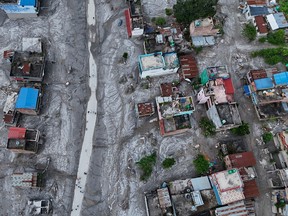
As the scale of the disaster that unfolded in the two countries becomes clearer, desperation is rising among the families of the nearly 3,000 still missing — a toll that authorities expect will continue to climb in the coming days. Rescue efforts are complicated by immense logistical challenges, with entire villages cut off from road access and at least hundreds of victims likely still trapped under sheets of rubble, mud and water.
Article content
Article content
Article content
For families of those missing or dead, new challenges are setting in. Many of those affected by the disaster, like Bhatta’s son, worked at hydropower projects, hotels, or tour companies operating along the rugged border between China and Nepal, adding to the logistical and bureaucratic complexity of the rescue operation. Others lived and worked in remote villages now cut off completely from contact — and in some cases from rescue teams.
Article content
Article content
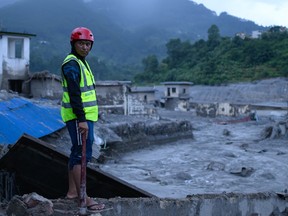
“It was a horror to walk around. It looks like a bomb blew up,” said David Fisher, head of the Nepal delegation for the International Federation of Red Cross and Red Crescent Societies. Fisher was in Nuwakot on Saturday, a heavily affected district in Nepal still partially accessible by road. “There’s nothing left. People have lost everything.”
Article content
On Saturday, Nepali Foreign Minister Shisir Khanal said the country was seeking specialized foreign assistance to help in the rescue and recovery effort, including technical assistance to help open tunnels where people were trapped, heavy-duty drones to help with supply drops to stranded areas and forensic assistance to help identify the dead.

