



Article content
Prime Minister Mark Carney always said he would walk away from a bad deal and has now done so.

THIS CONTENT IS RESERVED FOR SUBSCRIBERS
Enjoy the latest local, national and international news.
- Exclusive articles by Conrad Black, Barbara Kay and others. Plus, special edition NP Platformed and First Reading newsletters and virtual events.
- Unlimited online access to National Post.
- National Post ePaper, an electronic replica of the print edition to view on any device, share and comment on.
- Daily puzzles including the New York Times Crossword.
- Support local journalism.
SUBSCRIBE FOR MORE ARTICLES
Enjoy the latest local, national and international news.
- Exclusive articles by Conrad Black, Barbara Kay and others. Plus, special edition NP Platformed and First Reading newsletters and virtual events.
- Unlimited online access to National Post.
- National Post ePaper, an electronic replica of the print edition to view on any device, share and comment on.
- Daily puzzles including the New York Times Crossword.
- Support local journalism.
REGISTER / SIGN IN TO UNLOCK MORE ARTICLES
Create an account or sign in to continue with your reading experience.
- Access articles from across Canada with one account.
- Share your thoughts and join the conversation in the comments.
- Enjoy additional articles per month.
- Get email updates from your favourite authors.
THIS ARTICLE IS FREE TO READ REGISTER TO UNLOCK.
Create an account or sign in to continue with your reading experience.
- Access articles from across Canada with one account
- Share your thoughts and join the conversation in the comments
- Enjoy additional articles per month
- Get email updates from your favourite authors
Sign In or Create an Account
or
Article content
But as the prime minister urges us to rally round the flag — again — he also needs to give Canadians full details as to why the trade talks with the United States collapsed.
Article content
Recommended Videos
Article content
The Liberal government is pointing out that it was U.S. demands that led to the collapse of the latest round of trade talks. It may well be that it was the uncompromising American president and his negotiators who brought us to this point where we are about to engage in potentially catastrophic tit-for-tat tariffs.
Article content
Article content
But how exactly did we get here and why? How is it that Carney suspended trade talks after reports that we were close to a deal? It is not enough to point fingers. What Canadians need are the full details of what was being offered and why it was rejected.
Article content
By signing up, you consent to receive the above newsletter from Postmedia Network Inc.
Article content
In a late statement Friday night, the prime minister addressed none of those concerns.
Article content
“Canada has what the world wants. And we will not allow any nation to determine our future. We will set our own course to keep building Canada strong for all,” said the prime minister in his statement.
Article content
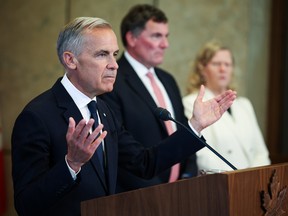
In a press conference Saturday, he repeatedly made the same refrain.
Article content
“We can’t control the storm that blows in from Washington,” he said in his introductory remarks. “We can, however, chart a new course by building Canada strong at home and diversifying our trading relationships abroad.
Article content
“We are masters in our own home and an excellent partner abroad.”
Article content
He later said, “Canadians will always take care of each other. We know we’re stronger together. In the last year and a half, Canadians have met this moment with resolve, with purpose, with strength.”
Article content
Article content
So here we are, back in Elbows Up territory. At least one good thing to come out of this trade war is that it will unite a majority of the country.
Article content
Article content
In his statement and his press conference, Carney said he decided to walk away from the trade negotiations because of unrealistic demands by the Americans.
Article content
“There were some things we wouldn’t do. We were not prepared to compromise Canada’s sovereignty or to undermine our key industries. We were not prepared to accept any compromise on our sovereignty, protection of the French language and our culture,” he said.
Article content
When pressed on specifics, Carney gave a few examples of friction between negotiators.
Article content
One was the auto sector. Earlier this week, the CBC reported that the U.S. was considering reducing auto tariffs down from 25 per cent to 15 per cent. But Carney said the U.S. wanted to limit the level of tariffs to cars only and exclude medium and heavy autos and light trucks. This would have made Canadian production “uneconomic,” he said.
Article content
Another major sticking point, said Carney, was the U.S. introducing at the last minute language that would have restricted Canada’s ability to make trade deals with other countries.

