



Batwara 1947 Review: Sunny Deol, Shabana Azmi and Karan Deol shine in Rajkumar Santoshi’s moving Partition drama that puts humanity above communal hatred.
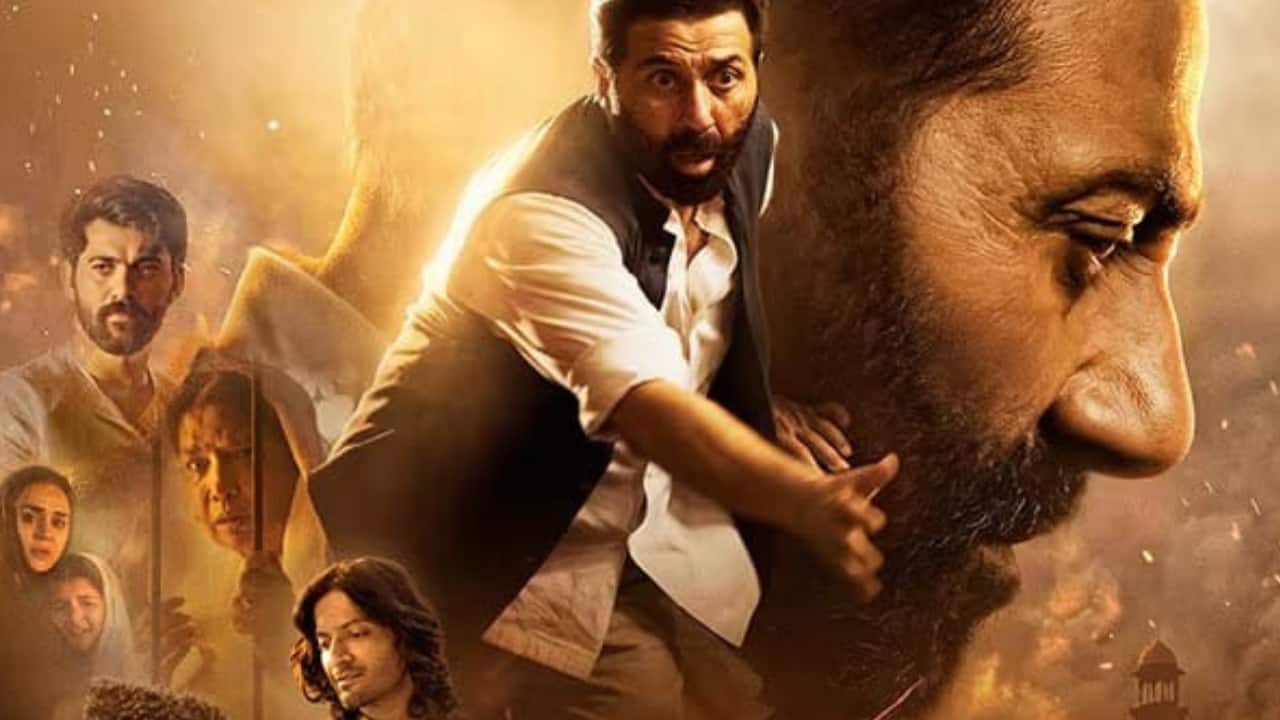
Movie: Batwara 1947
Cast: Sunny Deol, Preity Zinta, Ali Fazal, Karan Deol, Shabana Azmi
Director: Rajkumar Santoshi
Rating: 4.5 stars
Batwara 1947 Review: There is a moment in *Batwara 1947* when you realise that Rajkumar Santoshi is not really making a film about who won or lost in 1947. He is interested in something much more difficult: what happens to ordinary people when suddenly they are told that the neighbour they trusted yesterday belongs to the “other” side today. That is where Batwara 1947 finds its heart.
On the surface, this is a large period drama mounted on the canvas of Partition. There are crowded streets, fear, displacement, religious frenzy and the uncertainty of a newly divided land. But Santoshi keeps pulling us away from history-book headlines and towards people. A home that someone refuses to leave. A mother waiting for a son who may never return. A family discovering that compassion can sometimes demand more courage than violence. And standing at the centre of all this is Sunny Deol as Sikandar Mirza.
We have spent so much time discussing Sunny Deol’s “comeback” that perhaps we have missed the more interesting story. He is no longer making a comeback. He is entering a fascinating phase as an actor.
Sikandar has the authority we associate with Sunny Deol, and Santoshi naturally gives him dialogues that only that voice can carry. But the performance is not built merely around volume or physical power. Some of Sunny’s finest moments here arrive when he says very little. His affection for Mai, his anger at the madness unfolding around him and his determination not to surrender his humanity are communicated through restraint.
Perhaps that is why Sikandar feels heroic without being written as a conventional hero. His biggest battle is not to defeat another religion. It is to refuse to become hateful himself.
Shabana Azmi as Mai is extraordinary
There is stubbornness in her, humour, mischief, grief and an almost childlike faith that the world she knew cannot simply disappear because somebody has drawn a border. Shabana never asks the audience for sympathy. She earns our affection gradually until somewhere along the way Mai stops feeling like a character and begins feeling like someone’s grandmother.
The relationship between Sikandar and Mai is the soul of the film. A Muslim man and an elderly Hindu woman, technically separated by everything Partition wants them to be separated by, slowly become family. Santoshi does not need to underline the symbolism because Sunny and Shabana make us feel it.
Karan Deol deserves a special mention
Karan Deol deserves a special mention. Acting opposite Sunny Deol is difficult enough; doing it while also carrying the inevitable comparison of being his son must be harder still. Yet Karan stands his ground. His dialogue delivery has conviction, there is confidence in his confrontation scenes, and importantly he never appears to be performing an imitation of his father. He finds his own rhythm. This is easily one of his most assured performances and he is genuinely enjoyable to watch.
Batwara 1947 cast
The ensemble adds further depth. Preity Zinta brings warmth and emotional weight to the world of the film. Ali Fazal appears with a completely different energy — gentle, thoughtful and almost poetic. His scenes with Sikandar Mirza have a quietness that contrasts beautifully with the violence surrounding them. Abhimanyu Singh makes Yaqoob Pehelwan suitably threatening, becoming the face of the hatred that the film is ultimately arguing against.
The transition from celebrated stage material to cinema also deserves appreciation. Santoshi retains the importance of language, arguments and character confrontations, but opens the story visually. Production design, costumes, locations, cinematography and background score make Lahore and the chaos of 1947 feel lived-in rather than simply recreated for a movie set.
Batwara 1947’s second half wins praise
The second half is where the emotional weight begins accumulating almost silently. I would strongly recommend going in without reading spoilers, because the climax works precisely because of everything the film has made you feel about these people by then.
What I admired most about Batwara 1947 is that a film set during communal carnage chooses not to manufacture more hatred.
It asks a far more uncomfortable question: if everyone around you has begun seeing another human being only through religion, do you have the courage to continue seeing a human being?
Rajkumar Santoshi and Sunny Deol have made angry cinema together before. Here that anger seems older, wiser and more compassionate.
Batwara 1947 may be mounted as a historical epic, but its most powerful message is remarkably simple:
Countries can be divided. Homes can be divided. Land can be divided.
Humanity does not have to be. A moving, beautifully performed and deeply relevant film.

