


Article content
While China had hit back at the U.S. after their presidents steadied ties in a May summit, the measures were often largely symbolic because they targeted military suppliers with no business in the world’s second-largest economy. In June, for example, Beijing restricted exports to 10 U.S. military-related companies in response to the Pentagon’s decision to add some of China’s biggest tech firms to a roster of Chinese military backers.
Article content
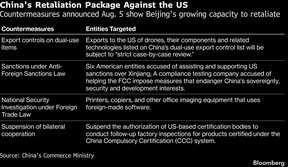
Some of the latest sanctions, however, targeted the infrastructure behind American restrictions, including companies and organizations involved in compliance, traceability, due diligence and auditing.
Article content
“This round of countermeasures whip up some real compliance headaches for multinationals,” said Ryan Etzcorn, a senior director at Ankura China Advisors. China is using existing tools to retaliate directly against risk consultants and due-diligence providers, extending the scope of its measures “into daily supply chain compliance” for manufacturers across industries, he said.
Article content
Article content
Six entities, including Applied DNA Sciences and Responsible Business Alliance, were sanctioned over their alleged involvement in U.S. restrictions on Chinese companies accused of using forced labor in Xinjiang. Beijing separately targeted Compliance Testing, an Arizona-based company it said had assisted the FCC in imposing restrictions against China.
Article content
Article content
As part of the retaliation package, China’s certification regulator said it’s decided to suspend the authorization of U.S.-based certification bodies to conduct follow-up factory inspections for products certified under the China Compulsory Certification system known as CCC.
Article content
CCC is a mandatory safety and quality certification required for designated products sold in China, whether made domestically or imported. As a result, U.S. manufacturers may have to arrange required follow-up inspections through authorized bodies outside the U.S., potentially raising costs and causing delays.
Article content
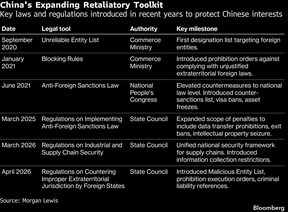
The Commerce Ministry also announced a national security investigation into printers, copiers, and other office imaging equipment that uses foreign-made software. The probe marks the first use of the mechanism created under China’s revised Foreign Trade Law, which took effect in March and expanded the government’s authority to respond to foreign sanctions and other restrictions.
Article content
Article content
The timing of the decisions adds to the pressure on both sides to contain the dispute before Xi’s highly anticipated trip, while leaving Beijing with further tools to deploy if the Trump administration presses ahead with additional restrictions.
Article content
Article content
“More aggressive actions — restricting Chinese open-weight AI models or curbing Chinese firms’ chip access through cloud services — would signal a step change in the administration’s approach and put the truce at risk,” Eurasia Group analysts including Dominic Chiu wrote in a note.
Article content
The two governments are trying to preserve a fragile trade truce while a wide range of disputes continue to simmer.
Article content
Senior officials from both sides discussed points of friction between their countries in a call last week. Chinese Vice Premier He Lifeng raised “serious concern” over recent economic and trade restrictions from Washington, while U.S. Treasury Secretary Scott Bessent called on Beijing to “fully meet” its commitments in providing access to rare earths and purchasing U.S. agricultural products.
Article content
Beijing’s sweeping response has been welcomed by nationalist voices within China, who see it as evidence that their government now has a stronger arsenal at its disposal to push back against U.S. pressure.
Article content
“China is no longer a nation that can only passively endure U.S. suppression, and its countermeasures are readily available,” Hu Xijin, former editor-in-chief of China’s state-backed nationalist tabloid Global Times, wrote on Weibo. “If the U.S. chooses to escalate bilateral trade friction and mutual technology export controls, China will, without a doubt, see it through to the end.”
Article content
Our website is the place for the latest breaking news, exclusive scoops, longreads and provocative commentary. Please bookmark nationalpost.com and sign up for our daily newsletter, Posted, here.
Article content

