


Article content
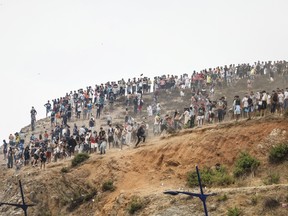
The Spanish city of Ceuta, which sits on a tiny coastal patch of North Africa within eyesight of mainland Spain, was readying to celebrate its patron saint this weekend — and then it was overwhelmed by a migrant horde.

THIS CONTENT IS RESERVED FOR SUBSCRIBERS
Enjoy the latest local, national and international news.
- Exclusive articles by Conrad Black, Barbara Kay and others. Plus, special edition NP Platformed and First Reading newsletters and virtual events.
- Unlimited online access to National Post.
- National Post ePaper, an electronic replica of the print edition to view on any device, share and comment on.
- Daily puzzles including the New York Times Crossword.
- Support local journalism.
SUBSCRIBE FOR MORE ARTICLES
Enjoy the latest local, national and international news.
- Exclusive articles by Conrad Black, Barbara Kay and others. Plus, special edition NP Platformed and First Reading newsletters and virtual events.
- Unlimited online access to National Post.
- National Post ePaper, an electronic replica of the print edition to view on any device, share and comment on.
- Daily puzzles including the New York Times Crossword.
- Support local journalism.
REGISTER / SIGN IN TO UNLOCK MORE ARTICLES
Create an account or sign in to continue with your reading experience.
- Access articles from across Canada with one account.
- Share your thoughts and join the conversation in the comments.
- Enjoy additional articles per month.
- Get email updates from your favourite authors.
THIS ARTICLE IS FREE TO READ REGISTER TO UNLOCK.
Create an account or sign in to continue with your reading experience.
- Access articles from across Canada with one account
- Share your thoughts and join the conversation in the comments
- Enjoy additional articles per month
- Get email updates from your favourite authors
Sign In or Create an Account
or
Article content
This is what happens when all of a country’s institutions orient themselves to help outsiders over their own people.
Article content
Recommended Videos
Article content
The festivities were called off, but that was the least of the locals’ concerns. Some 60,000 people, primarily young men, entered the city from Morocco over several days by swimming around the border fence. They were hungry, thirsty, barefoot and without a place to stay. Videos circulated online of the masses milling about, of street violence, of men scaling apartments and attempting to gain entry.
Article content
Article content
We’ll have a tally of the actual damage and crime once the dust settles, but the breakdown of law and order is plain enough. What the city experienced was nothing short of an invasion, which presents serious national security concerns.
Article content
By signing up, you consent to receive the above newsletter from Postmedia Network Inc.
Article content
Spanish officials estimated on Friday evening that 48,300 migrants had returned to Morocco, but the thousands who remain can’t immediately be forced to leave. That’s because, earlier this month, the Spanish Supreme Court made it illegal to summarily deport anyone who enters Spain by sea.
Article content
If it was exclusively the top Spanish court working to advance the interests of illegal migrants, perhaps this problem would have been easier to prevent. But that was far from the case.
Article content
Socialist Prime Minister Pedro Sánchez set out earlier this year to mass-regularize those living unlawfully in Spain, and by late June had received more than one-million applications for the scheme. Before that, he embarked on an African strategy that involves funnelling aid abroad and providing work visas to migrants, with the overall effect of fostering warm ties with migrant-sending countries. The CBC has taken note, giving Spain’s uniquely welcoming approach to immigration a positive spin, contrasting it with souring attitudes over in the United Kingdom.
Article content
Article content
Reality hits hard. On Friday, Sánchez called Ceuta’s migrant tide a “violation of Spain’s territorial integrity” that deserves “condemnation at the strongest possible level.” He empathized with the locals, who had been advised to batten down and cower in place. Speaking words and sounding defensive is an easy thing to do. Much like our leaders in Canada, Sánchez’s apparent support for integrity and order was contradicted by his record of lax administration of the immigration system.
Article content
A kinder welcome was extended by the local Catholic church. On Thursday, the Diocese of Cádiz and Ceuta “expressed its closeness to all those affected by the crisis” and “announced that all collections taken this weekend in Ceuta’s parishes will be allocated to the Diocesan Office for Migrants,” according to Vatican News.
Article content
Small-scale charity work was going on in the city, as well: the Spanish publication El País followed a young Arab woman from Ceuta who was handing out sandwiches to the migrants on Friday, telling them that local officers can be trusted and informing them of the Supreme Court precedent against their immediate deportation — which was met with “enthusiastic applause.”

