


From the pretty boys of ‘Boys Over Flowers’ to the sheer resilience of ‘Agent Kim Reactivated,’ how a couple of middle-aged men became the most swoon-worthy heroes on television in 2026.
If you’ve been following K-dramas for a while, you already know that the definition of what constitutes a hero has been in a state of flux. For nearly two decades, the face of Korean television was built on this specific, almost flawless standard of male beauty. Think back to 2009, when Lee Min-ho strutted onto our screens as Gu Jun-pyo in Boys Over Flowers. That era gave us the kkotminam, or “flower boys” — handsome young men of androgynous charm who flipped the gruff, rugged hero stereotype on its head. It wasn’t just about good looks but a safe, idealized fantasy: men who were gentle, emotionally expressive, and styled to perfection.
This focus on soft, comforting aesthetics naturally created an appetite for characters who could pair that visual polish with societal power. The industry answered by aging those pretty boys into sleek, brooding chaebol (Korean conglomerate) heirs. Stars like Hyun Bin in Secret Garden (2010) and Park Seo-joon in What’s Wrong with Secretary Kim (2018) set a new template of wealthy twenty-something tycoons, emotionally locked away until a quirky romance melted their coldness. We fell for their dreamy looks, overlooked their toxic boundaries, and bought into the trope of the rich heir who only needs love to change.
As romance tropes grew predictable, creators looked for adrenaline. The setting shifted from boardrooms to intense action thrillers, but youth and agility still stayed non-negotiable. We saw a ripped young Ji Chang-wook scale buildings and dodge bullets with ease in Healer (2014) and The K2 (2016) as a lethal undercover operative, capturing our imagination as the young action heartthrob with a killer physique.
The industry’s tryst with youthful charm peaked in the high-school space. Mega-hits like Cha Eun-woo’s True Beauty (2020) won hearts with their picture-perfect coming-of-age narratives. For years, K-dramas seemed committed to this bubble of perfection, steering clear of anything that let harsh reality slip in. Even when dramas turned toward the supernatural, the formula hadn’t really changed. Lee Jun-ho in Cashero (2025) played an ordinary man whose supernatural strength is tied to the cash in his wallet. Around the same time, Cha Eun-woo traded his high-school charm for an awkward hometown hero navigating doomsday panic in The Wonderfools (2026). In these stories, the premise leaned into everyday struggles, but the men still looked young and perfect.
However, beneath the surface, a cultural shift was underway: the audience was growing up. The teenagers who swooned over the F4 boys on the Shinhwa campus in Boys Over Flowers are now adults faced with their own tedious responsibilities, jobs, and family life. At the same time, the global rise of streaming services has paved the way for darker, more mature storytelling. So, the pristine corporate heir fighting his parents for love has now started to feel hollow. What appeals more are grittier narratives and characters who carry the weight of lived experiences.
And that’s where the gloss ends, and the era of the middle-aged K-drama hero begins.
The reigning kings of Korean television are now rough-around-the-edges, scarred, and, at times, morally compromised. They are visibly tired men in their late thirties, forties, and fifties, who come with graying sideburns, deep laugh lines, and a weariness that completely changes the gravity of the story the moment they enter the scene. You can feel the physical exhaustion in their posture and the emotional toll of their scars. They may be divorced, single parents, navigating a crushing corporate job or desperately trying to keep a business afloat. They aren’t fighting for vanity or abstract romantic notions, but because they have something real left to protect—and surprisingly, it’s this beautifully flawed survival that’s making us swoon over the new face of the K-drama hero.
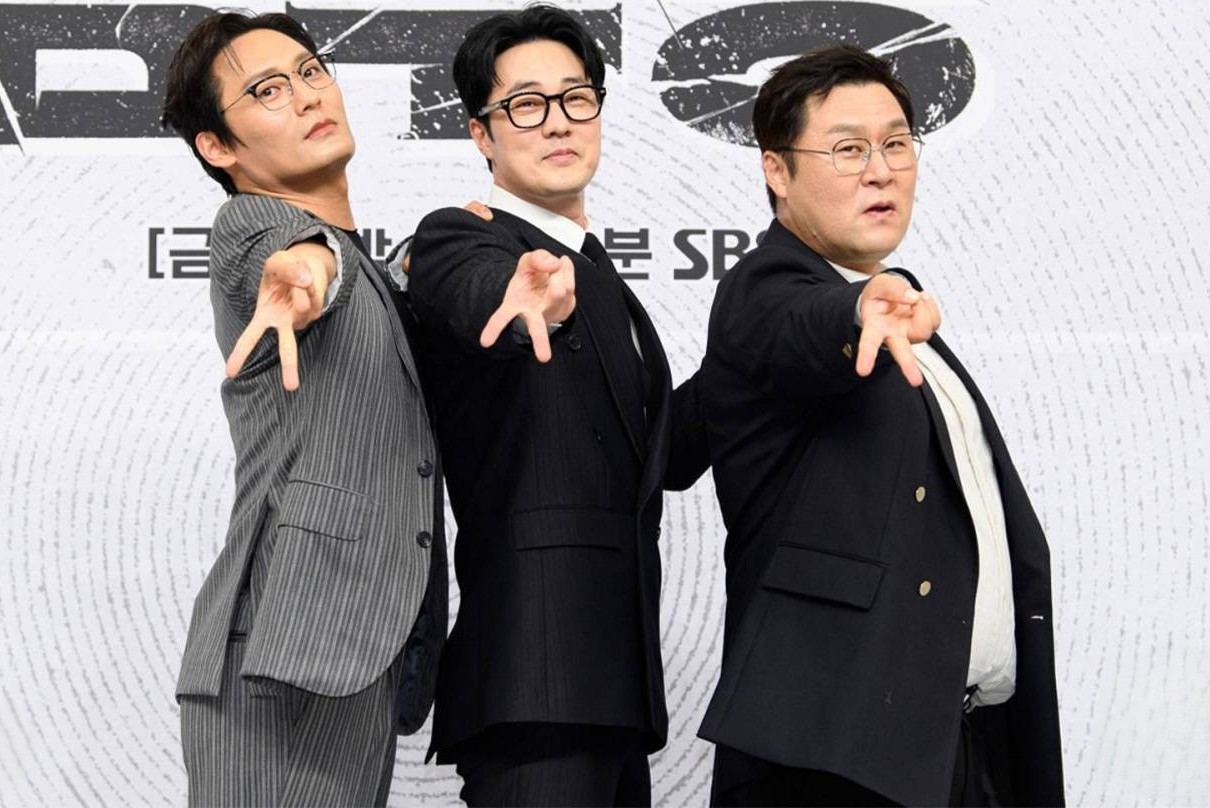
The shift is most felt in the evolution of the average family man. In the hit series Agent Kim Reactivated (2026), So Ji-sub plays Kim Do-hyeon, a regular office worker and a single father whose biggest challenge is trying to connect with his teenage daughter. But the moment she suddenly goes missing, his life takes an unexpected turn, and the lethal combat skills from his secret past as a covert agent come roaring back to life.
What makes this show brilliant is how it treats a father’s sheer desperation as the ultimate superpower. Instead of force-fitting a typical romance subplot, the story locks into a brutal fight for survival. The drama resonated worldwide; according to Nielsen Korea ratings reported by The Korea Times, the domestic premiere pulled in a huge 9.5 percent nationwide rating, which then jumped to 15.7 percent by the second episode. No prime-time series had climbed that fast in roughly five years. Streaming tracking data highlighted by Korea.net showed the series dominating globally, safely holding the number one spot on Netflix’s Global Top 10 Non-English TV chart for three weeks with over 8.2 million weekly views.
Kim becomes a true hero of life because when he throws a punch, it isn’t a display of martial arts skills but a heavy blow born of a parent’s worst nightmare. He’s fighting a broken legal system and corrupt people to bring his child home. Anchored by the solid camaraderie between So Ji-sub and his co-stars Choi Dae-hoon and Yoon Kyung-ho — who play his closest friends and former fellow agents — their willingness to go to extreme lengths to help Kim get his child back while flexing their own formidable skill sets left a mark, underlining that age is just a number.
A similar realism drives Teach You a Lesson (2026). This smash-hit series goes beyond the traditional school-drama tropes to examine systemic societal decay, the collapse of classroom authority, and corruption. Instead of an idealistic young teacher saving the day, the story stars veteran actor Lee Sung-min as Choi Gang-seok, an elite supervisor from the Educational Rights Protection Bureau. Alongside Kim Mu-yeol’s rogue inspector Na Hwa-jin, he approaches school violence with the hardened, pragmatic cynicism of older adults who know exactly how corrupt the world is. Hence, he resorts to using uncompromising and often unconventional methods to force accountability. Lee Sung-min doesn’t need to engage in physical fistfights to command the screen; his expressions and magnetic presence do that for him, helping him sell the story of a hero who’s spent decades fighting an uphill battle against an extremely rigged system.
Next up, The Husband (2026) shifts the focus from public institutions to the dark corners of a collapsing marriage. In this thriller, Namkoong Min discards the polished hero image to explore the vulnerability of a crumbling life. He stars as Kang Tae-ju, a brilliant former neurosurgeon turned hospital director whose life goes south when his estranged wife, played by Lee Seol, is abducted the day after they agree to a divorce. Framed as the prime suspect, Tae-ju becomes a hunted fugitive and a relentless pursuer. Namkoong Min plays the character as a frantic, breathless man watching his status and everything he’s built for years disintegrate in real time. His heroism is driven by overwhelming regret over failing to save his dying child because of work and inadvertently putting a target on his wife’s back, coupled with a stubborn refusal to ever let her be harmed again.
On the lighter side, the action-comedy Husbands in Action (2026) takes all that baggage and turns it into a hilariously wild ride. It pairs Jin Seon-kyu, playing a cynical veteran detective named Choong-sik, with Gong Myung, who plays a veterinarian named Min-seok. The twist is that Min-seok is married to Choong-sik’s ex-wife. When she gets kidnapped by a drug cartel, these two ordinary men have to team up for a chaotic rescue mission. The whole situation gets out of hand when the cartel leader, Do-jun (Kim Ji-suk), actually joins them to save his own wife from a different syndicate. It’s a fun, messy look at how middle-aged men are ruling the screen right now — proving that you can be tired, divorced, and completely overwhelmed, but still step up when it matters.
Meanwhile, The Apartment Job (2026) shows that a hero can emerge from the most unlikely places. Ji Sung stars as Park Hae-gang, a former gang boss running a fraudulent investment front. Desperate to raise billions to save the elderly mentor who raised him, Hae-gang tries to become the president of a luxury apartment complex to steal its repair funds. What follows is a chaotic spin on the classic neighborhood hero. As Hae-gang attempts to pull off his heist, his criminal instincts collide with the local syndicate, class disputes between owners and their tenants, and greedy elites living in the complex. Ji Sung is brilliant as a man torn between his own survival and a growing, unexpected sense of responsibility for the families around him, evolving from a criminal into a savior.
The success of these projects is a sign that heroes don’t need a filter anymore. What hits now are characters with scars, mistakes, and something real to fight for. They don’t need youth or beauty, just a sense of humanity. And watching them command a scene with nothing but tired eyes and determination is more powerful than anything else.

