
Jack Jedwab: The seeds of today’s efforts to excuse antisemitism were planted 25 years ago in Durban

Article content
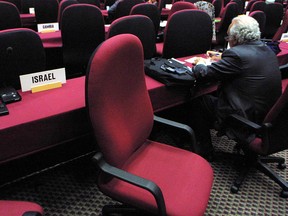
Attempts to paint antisemitism as a form of political expression rather than racism is far from a recent phenomenon. The clearest example of where this idea fermented on the world stage was the World Conference Against Racism (WCAR) in Durban, South Africa, which was held 25 years ago.

THIS CONTENT IS RESERVED FOR SUBSCRIBERS
Enjoy the latest local, national and international news.
- Exclusive articles by Conrad Black, Barbara Kay and others. Plus, special edition NP Platformed and First Reading newsletters and virtual events.
- Unlimited online access to National Post.
- National Post ePaper, an electronic replica of the print edition to view on any device, share and comment on.
- Daily puzzles including the New York Times Crossword.
- Support local journalism.
SUBSCRIBE FOR MORE ARTICLES
Enjoy the latest local, national and international news.
- Exclusive articles by Conrad Black, Barbara Kay and others. Plus, special edition NP Platformed and First Reading newsletters and virtual events.
- Unlimited online access to National Post.
- National Post ePaper, an electronic replica of the print edition to view on any device, share and comment on.
- Daily puzzles including the New York Times Crossword.
- Support local journalism.
REGISTER / SIGN IN TO UNLOCK MORE ARTICLES
Create an account or sign in to continue with your reading experience.
- Access articles from across Canada with one account.
- Share your thoughts and join the conversation in the comments.
- Enjoy additional articles per month.
- Get email updates from your favourite authors.
THIS ARTICLE IS FREE TO READ REGISTER TO UNLOCK.
Create an account or sign in to continue with your reading experience.
- Access articles from across Canada with one account
- Share your thoughts and join the conversation in the comments
- Enjoy additional articles per month
- Get email updates from your favourite authors
Sign In or Create an Account
or
Article content
WCAR was billed as a global gathering to combat racism, xenophobia and intolerance. Governments, international organizations and civil society representatives assembled with the stated purpose of building a shared framework against racism in all its forms. There was a sense that history would be made.
Article content
Recommended Videos
Article content
Article content
I was there to witness it unfold first-hand. I had not travelled to Durban as an advocate or as someone looking to advance Jewish community concerns. In preparation for the conference, I had been commissioned to produce a report for the Government of Canada’s anti-racism secretariat that examined previous reports and recommendations on racism, racial discrimination and related intolerance. In effect, I arrived in Durban expecting conversations about combating racism in all its forms. Instead, what I encountered there was almost the opposite. And therein lies one of the bitter irony of the experience.
Article content
By signing up, you consent to receive the above newsletter from Postmedia Network Inc.
Article content
At the parallel NGO Forum, where civil society leaders from around the world were meant to give expression to the victims of racism and discrimination, the proceedings were transformed — or more accurately hijacked — into something much uglier. What should have been a universal anti-racism gathering became, in too many instances, an effort to remove Jew-hatred from the world’s anti-racism agenda. The spectacle was marked by manipulation, propaganda and a stunning willingness to excuse hostility toward Jews and dress it up as anti-Zionism or anti-Israel politics.
Article content
Article content
Jewish participants from across the political spectrum arrived expecting solidarity. Instead, many of us found ourselves asking whether antisemitism still counted as racism. Some participants described being harassed because they were visibly Jewish. Copies of “The Protocols of the Elders of Zion,” the notorious antisemitic forgery, were circulated. Posters equated Israel with Nazi Germany. Leaflets and slogans blurred, sometimes deliberately, any distinction between criticism of Israeli government policy and hostility toward Jews as a people. Conduct that would have been immediately condemned had it targeted virtually any other minority was tolerated, rationalized or ignored when directed at Jews.
Article content
Article content
That was the disturbing innovation of Durban. It helped globalize the effort to recast the hatred of Jews as political opinion. The very language of anti-racism was used to launder antisemitic expression. Jews were not denied the right to be protected in theory; rather, they were told that the hostility directed at them was not really hatred at all, but solidarity with the oppressed, anti-colonial activism or resistance to imperialism.
Copyright © 2026 Jwala Varadhi – Telugu Breaking News, AP, Telangana, Politics & Latest Updates. All rights reserved.
 প্রিন্ট করুন
 সেভ করুন